Crypto Interrupted: Data On The WPS WiFi Break

TL,DR:  Went wardriving around Berlin. 26.3% of APs with crypto enabled exposed methods that imply vulnerability to the WPS design flaw.  A conservative extrapolation from WIGLE data suggests at least 4.1M vulnerable hosts.  Yikes.

=======

Fixing things is hard.  Fixing things in security, even more so.  (There’s a reasonable argument that the interlocking dependencies of security create a level of Hard that is mathematically representable.) And yet, WiFi was quietly but noticeably one of our industry’s better achievements.  Sure, WiFi’s original encryption algorithm — WEP — was essentially a demonstration of what not to do when deploying cryptographic primitives.  And indeed, due to various usability issues, it used to be rare to see encryption deployed at all.  But, over the last ten years, in a conversion we’ve notably not witnessed with SSL (at least not at nearly the same scale)…well, take a look:

Original source: https://dakami1.files.wordpress.com/2012/01/crypto.png?w=595

In January 2002, almost 60% of AP’s seen worldwide by the WIGLE wireless mapping project had encryption disabled.  Ten years later, only 20% remained, and while WEP isn’t gone, it’s on track to be replaced by WPA/WPA2. You can explore the raw data here, and while there’s certainly room to argue about some of the numbers, it’s difficult to say things haven’t gotten better.

Which is what makes this WPS flaw found by Stefan Viehböck (and independently discovered by Craig Heffner) quite so tragic.

Read the rest of this entry »

From 0day to 0data: TelnetD

Recently, it was found that BSD-derived Telnet implementations had a fairly straightforward vulnerability in their encryption handler. (Also, it was found that there was an encryption handler.) Telnet was the de facto standard protocol for remote administration of everything but Windows systems, so there’s been some curiosity in just how nasty this bug is operationally.

So, with the help of Fyodor and the NMAP scripting team, I set out to collect some data on just how widespread this bug is. First, I set out to find all hosts listening on tcp/23. Then, with Fyodor’s code, I checked for encryption support. Presence of support does not necessarily imply vulnerability, but absence does imply invulnerability.

The scanner’s pretty rough, and I’m doing some sampling here, but here’s the bottom line data:

Out of 156113 confirmed telnet servers randomly distributed across the Internet, only 429 exposed encryption support. By far my largest source of noise is the estimate of just how many telnet servers (as opposed to just TCP listeners on 23, or transient services) exist across the entire Internet. My conservative numbers place that count at around 7.8M. This yields an estimate of ~13785 ~21546 (or 15,600 to 23,500, at 95% confidence — thanks, David Horn!) potentially vulnerable servers.

Patched servers will still look vulnerable unless they remove encryption support entirely, so this isn’t something we can watch get fixed (well, unless we’re willing to crash servers, which I’m not, even if it’d be safe because these things are launched from inetd).

Here is a command line that will scan your networks. You may need nmap from svn.

Read the rest of this entry »

Exploring ReU: Rewriting URLs For Fun And XSRF/HTTPS

So I’ve been musing lately about a scheme I call ReU. It would allow client side rewriting of URLs, to make the addition of XSRF tokens much easier. As a side effect, it should also make it much easier to upgrade the links on a site from http to https. Does it work? Is it a good idea? I’m not at all sure. But I think it’s worth talking about:

===

There is a consistent theme to both XSS and XSRF attacks: XS. The fact that foreign sites can access local resources, with all the credentials of the user, is a fundamental design issue. Random web sites on the Internet should not be able to retrieve Page 3 of 5 of a shopping cart in the same way they can retrieve this blog entry! The most common mechanism recommended to prevent this sort of cross-site chicanery is to use a XSRF token, like so:

http://foo.com/bar?session_id=12345

The token is randomized, so now links from the outside world fail despite having appropriate credentials in the cookie.

In some people’s minds, this is quite enough. It only needs to be possible to deploy secure solutions; cost of deployment is so irrelevant, it’s not even worth being aware of. The problem is, somebody’s got to fix this junk, and it turns out that retrofitting a site with new URLs is quite tricky. As Martin Johns wrote:

Read the rest of this entry »

These Are Not The Certs You’re Looking For

It began near Africa.

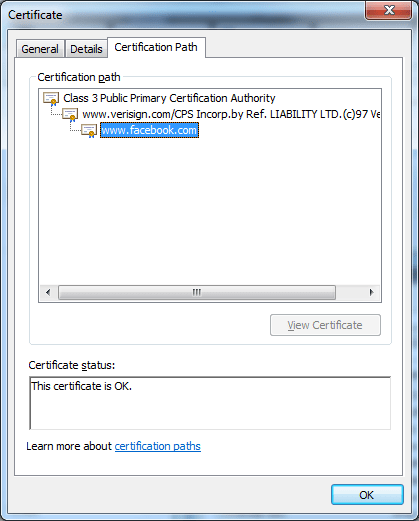
Original source: https://i0.wp.com/s3.amazonaws.com/dmk/facebook_by_verisign.png

This is not, of course, the *.google.com certificate, seen in Iran, signed by DigiNotar, and announced on August 29th with some fanfare.

This certificate is for Facebook. It was seen in Syria, signed by Verisign (now Symantec), and was routed to me out of the blue by a small group of interesting people — including Stephan Urbach, “The Doctor”, and Meredith Patterson — on August 25th, four days prior.

It wasn’t the first time this year that we’d looked at a mysterious certificate found in the Syrian wild. In May, the Electronic Frontier Foundation reported that it “received several reports from Syrian users who spotted SSL errors when trying to access Facebook over HTTPS.” But this certificate would yield no errors, as it was legitimately signed by Verisign (now Symantec).

But Facebook didn’t use Verisign (now Symantec). From the States, I witnessed Facebook with a DigiCert cert. So too did Meredith in Belgium, with a third strike from Stephan in Belgium: Facebook’s CA was clearly DigiCert.

Read the rest of this entry »

Black Ops of TCP/IP 2011

This year’s Black Hat and Defcon slides!

Man, it’s nice to be playing with packets again!

People seem to be rather excited (ForbesDark ReadingSearch Security) about the Neutrality Router I’ve been working on. It’s called N00ter, and in a nutshell, it normalizes your link such that any differences in performance can’t be coming from different servers taking different routes, and have to instead be caused at the ISP. Here’s a summary of what I posted to Slashdot, explaining more succinctly what N00ter is up to.

Say Google is 50ms slower than Bing. Is this because of the ISP, or the routers and myriad server and path differentials between the ISP and Google, vs. the ISP and Bing? Can’t tell, it’s all conflated. We have to normalize the connection between the two sites, to measure if the ISP is using policy to alter QoS. Here’s how we do this with n00ter.

Start with a VPN, that creates an encrypted link from a Client to a broker/concentrator. An IP at the Broker talks plaintext with Google and Bing, who replies to the Broker. The Broker now encrypts the traffic back to the Client.

Policy can’t differentiate Bing traffic from Google traffic, it’s all encrypted.

Now, lets change things up — let’s have the Broker push the response traffic from Google and Bing, completely in the open. In fact, lets have it go so far as to spoof traffic from the original sources, making it look like there isn’t even a Broker in place. There’s just nice clean streams from Google and Bing.

If traffic from the same host, being sent over the same network path, but looking like Google, arrives faster (or slower) than traffic that looks like it came from Bing, then there’s policy differentiating Google from Bing.

Now, what if the policy is only applied to full flows, and not half flows? Well, in this case, we have one session that’s a straight normal download from Bing. Then we have another, where the entire client->server path is tunneled as before, but the Broker immediately emits the tunneled packets to Bing *spoofing the Client’s IP address*. So basically we’re now comparing the speed of a full legitimate flow to Bing, with a half flow. If QoS differs — as it would, if policy is only applied to full flows, then once again the policy is detected.

I call this client->server spoofing mode Roto-N00ter.

There’s more tricks, but this is what N00ter’s up to in a nutshell. It should work for anything IP based — if you want to know if XBox360 traffic routes faster than PS3 traffic, this’ll tell you.

Also, I’ve been doing some interesting things with BitCoin. (Len, we’ll miss you.) A few weeks ago, I gave a talk at Toorcon Seattle on the subject. Here are those slides as well.

Where’s the code? Well, two things are slowing down Paketto Keiretsu 3.0 (do people even remember scanrand?). First, I could use a release manager. I swear, packing stuff up for release is actually harder in many ways than writing the code! I do admit to know TCP rather better than Autoconf.

Secondly, and I know this is going to sound strange — I’m really not out to bust anyone with N00ter. Yes, I know it’s inevitable. But if a noxious filter is quietly removed with the knowledge that it’s presence is going to be provable in a court of law, well, all’s well that ends well, right?

Read the rest of this entry »

New York Times coming out against DNS filtering

This is rather cool: The New York Times is citing our paper and agreeing that filtering DNS for intellectual property violations would be both ineffective and counterproductive.

Some of the remedies are problematic. A group of Internet safety experts cautioned that the procedure to redirect Internet traffic from offending Web sites would mimic what hackers do when they take over a domain. If it occurred on a large enough scale it could impair efforts to enhance the safety of the domain name system.

This kind of blocking is unlikely to be very effective. Users could reach offending Web sites simply by writing the numerical I.P. address in the navigator box, rather than the URL. The Web sites could distribute free plug-ins to translate addresses into numbers automatically.

The bill before the Senate is an important step toward making piracy less profitable. But it shouldn’t pass as is. If protecting intellectual property is important, so is protecting the Internet from overzealous enforcement.

Read the full entry »

On The RSA SecurID Compromise

TL;DR: Authentication failures are getting us owned. Our standard technology for auth, passwords, fail repeatedly — but their raw simplicity compared to competing solutions drives their continued use. SecurID is the most successful post-password technology, with over 40 million deployed devices. It achieved its success by emulating passwords as closely as possible. This involved generating key material at RSA’s factory, a necessary step that nonetheless created the circumstances that allowed a third party compromise at RSA to affect customers like Lockheed Martin. There are three attack vectors that these hackers are now able to leverage — phishing attacks, compromised nodes, and physical monitoring of traveling workers. SecurID users however are at no greater risk of sharing passwords, a significant source of compromise. I recommend replacing devices in an orderly fashion, possibly while increasing the rotation rate of PINs. I dismiss concerns about source compromise on the grounds that both hardware and software are readily reversed, and anyway we didn’t change operational behavior when Windows or IOS source leaked. RSA’s communications leave a lot to be desired, and even though third party security dependencies are tolerable, it’s unclear (even with claims of a “shiny new HSM”) whether this particular third party security dependency should be tolerated.


Table Of Contents:

INTRODUCTION MINIMIZING CHANGE MANDATORY RECOVERY ACTIONABLE INTELLIGENCE ARE THINGS BETTER?

INTRODUCTION There’s an old story, that when famed bank robber Willie Sutton was asked why he robbed banks, he replied: “Because that’s where the money is.” Why would hackers hit RSA Security’s SecurID authenticators?

Because that’s where the money is.

The failure of authentication technologies is one of the three great issues driving the cyber security crisis (the other two being broken code and invulnerable attackers). The data isn’t subtle: According to Verizon Business’ Data Breach Investigative Report, over half of all compromised records were lost to attacks in which a credential breach occurred. Realistically, that means passwords failed us in some way yet again.

Read the rest of this entry »

LA Times Defends DNS

The Los Angeles Times has come out in support of our position on recursive DNS filtering!

The main problem with the bill is in its effort to render sites invisible as well as unprofitable. Once a court determines that a site is dedicated to infringing, the measure would require the companies that operate domain-name servers to steer Internet users away from it. This misdirection, however, wouldn’t stop people from going to the site, because it would still be accessible via its underlying numerical address or through overseas domain-name servers.

A group of leading Internet engineers has warned that the bill’s attempt to hide piracy-oriented sites could hurt some legitimate sites because of the way domain names can be shared or have unpredictable mutual dependencies. And by encouraging Web consumers to use foreign or underground servers, the measure could undermine efforts to create a more reliable and fraud-resistant domain-name system. These risks argue for Congress to take a more measured approach to the problem of overseas rogue sites.

Indeed.

Read the full entry »

DNS Filtering Threatens the Security and Stability of the Internet

The DNS works. It creates the shared namespace that allows applications to interoperate across LANs, organizations, and even countries. With the advent of DNSSEC, it’s our best opportunity to finally address the authentication flaws that are implicated in over half of all data breaches.

There are efforts afoot to manipulate the DNS on a remarkably large scale. The American PROTECT IP act contains several reasonable and well targeted remedies to copyright infringement. One of these remedies, however, is to leverage the millions of recursive DNS servers that act as accelerators for Internet traffic, and convert them into censors for domain names in an effort to block content.

Filtering DNS traffic will not work, and in its failure, will harm both the security and stability of the Internet at large.

But don’t take just my word for it. I’ve been fairly quiet about PROTECT IP since when it was referred to as COICA, working behind the scenes to address the legislation. A common request has been a detailed white paper, deeply elucidating the technical consequences of Recursive DNS Filtering.

Today, I — along with Steve Crocker, author of the first Internet standard ever, Paul Vixie, creator of many of the DNS standards and long time maintainer of the most popular name server in the world, David Dagon, co-founder of the Botnet fighting firm Damballa, and Danny MacPherson, Chief Security Officer of Verisign — release Security and Other Technical Concerns Raised by the DNS Filtering Requirements in the PROTECT IP Bill.

Thanks go to many, but particularly to the staffers who have been genuinely and consistently curious — on both sides of the aisle — about the purely technical impact of the Recursive DNS Filtering provisions. A stable and secure Internet is not a partisan issue, and it’s gratifying to see this firsthand.

Read the full entry »

VUPEN vs. Google: They’re Both Right (Mostly)

TL,DR: Identifying the responsible party for a bug is hard. VUPEN was able to achieve code execution in Google’s Chrome browser, via Flash and through a special but limited sandbox created for the Adobe code. Chrome ships Flash with Chrome and activates it by default, so there’s no arguing that this a break in Chrome. However, it would represent an incredibly naive metric to say including Flash in Chrome has made it less secure. An enormous portion of the user population installs Flash, alongside Acrobat and Java, and by taking on additional responsibility for their security (in unique and different ways), Google is unambiguously making users safer. In the long run, sandboxes have some fairly severe issues, among which is the penchant for being very slow to repair once broken, if they can even be fixed at all. But in the short run, it’s hard to deny they’ve had an effect, exacerbating the “Hacker Latency” that quietly permeates computer security. Ultimately though, the dam has broken, and we can pretty much expect Flash bearing attackers to drill into Chrome at the next PWN2OWN. Finally, I note that the sort of disclosure executed by VUPEN is far, far too open to both fraudulent abuse and simple error, the latter of which appears to have occurred. We have disclosure for a reason. And then I clear my throat.

SECTIONS Introduction Plug-In Security The Trouble With Sandboxes Hacker Latency Uncoordinated Disclosure

EARLY DISCUSSION Dark Reading: Two Zero Day Flaws Used To Bypass Google Chrome Security Google, VUPEN spar over Chrome Hack


Introduction [Not citing in this document, as people are not speaking for their companies and I don’t want to cause trouble there. Please mail me if I have permission to edit your cites into this post. I’m being a little overly cautious here. This post may mutate a bit.]

VUPEN vs. Google. What a fantastic example of the danger of bad metrics.

In software development, we have an interesting game: “Who’s bug is it, anyway?” Suppose there’s some troublesome interaction between a client and a server. Arguments along the lines of “You shouldn’t sent that message, Client!” vs. “You should be able to handle this message, Server!” are legendary. Security didn’t invent this game, it just raised the stakes (and, perhaps, provides guidance above and beyond ‘what’s cheapest’).

Read the rest of this entry »