You Set The Rules

Stopped by AT&T ThreatTraq and talked about, you know.  Infosec.  Good times!  Here’s video and a transcript.

====

You set the rules and you get to CHEAT (with Dan Kaminsky) AT&T ThreatTraq #143

Brian Rexroad: Hello. Welcome to AT&T ThreatTraq for May 12th, 2015. This program provides network security highlights, discussion, and countermeasures for cyber threats. Today, we’re joined by Dan Kaminsky. Dan, welcome. You know, you’re one that practically needs no introduction, but I understand you’re Chief Scientist at White Ops.

Dan Kaminsky: Mm-hmm.

Brian: And can you tell us a little more about White Ops, and what you do?

Dan: We make sure that people on the Internet are actually people, because sometimes they’re not. Sometimes they’re just machines that have been programmed to run around. We always wondered why all these machines were getting broken into, like how interesting can Grandma’s email be? Well, it turns out you hack a million grandma’s. You click a billion ads, you make a million dollars. So we’re in the business of cleaning up the advertising ecosystem, and dealing with other situations where these automated machines, known as bots, run around and do bad things.

Read the rest of this entry »

The Little MAC Attack

THIS IS NOT A BREAK OF HMAC.  THIS IS NOT A BREAK OF HMAC.  THIS IS NOT A BREAK OF HMAC.

That being said:

Let bz=blocksize(h), k=a[0:bz]^(0x36*bz): If h(a)==h(b) and a[0:bz]==b[0:bz], then hmac(k, a[bz:])==hmac(k, b[bz:])

Given a hash function with a collision and a key either known or controlled by an attacker, it’s trivially possible to generate a HMAC collision.  The slightly less quick and dirty steps are:

1) Start with a file at least 64 bytes long 2) Generate a collision that can append to that file. 3) XOR the first 64 bytes of your file with 0x36’s.  Make that your HMAC key. 4) Concatenate the rest of your file with your colliding blocks.  Make those your HMAC messages. 5) HMAC(key, msg1+anything) will equal HMAC(key, msg2+anything)

Here’s the quick demo:

>>> f ‘ffffffffffffffffffffffffffffffffffffffffffffffffffffffffffffffff”Fresh Prince Of Bel-Air (Theme Song)”\n\nNow, this is a story all about how\nMy life got flipped-turned upside down\nAnd I\’d like to take a minute\nJust sit right there\nI\’ll tell you how I became the prince of a town called Bel Air\n\nIn west Philadelphia born a’ >>> key=f[0:64] >>> key ‘ffffffffffffffffffffffffffffffffffffffffffffffffffffffffffffffff’ >>> trans_36 = bytearray((x ^ 0x36) for x in range(256)) >>> key=key.translate(trans_36) >>> key ‘PPPPPPPPPPPPPPPPPPPPPPPPPPPPPPPPPPPPPPPPPPPPPPPPPPPPPPPPPPPPPPPP’ >>> msg=f[64:] >>> collision0==collision1 # calculated w/ md5coll, thanks Stach! False >>> hmac.new(key, msg+collision0).hexdigest() ‘917e8efe9a5c692e50b86e9581c509f3’ >>> hmac.new(key, msg+collision1).hexdigest() ‘917e8efe9a5c692e50b86e9581c509f3’ >>> hmac.new(key, msg+collision0+”can also append arbitrary content”).hexdigest() ‘b8a879d7cc7a89ed59d0768fdfec3351’ >>> hmac.new(key, msg+collision1+”can also append arbitrary content”).hexdigest() ‘b8a879d7cc7a89ed59d0768fdfec3351’

How cool is that???

Read the rest of this entry »

Not Safe For Not Working On

There’s an old Soviet saying:

If you think it, don’t say it. If you say it, don’t write it. If you write it, don’t be surprised.

It’s not a pleasant way to live.  The coiner of this quote was not celebrating his oppression.  The power of the Western brand has long been associated with its outright rejection of this sort of thought policing.

In the wake of a truly profound compromise of sensitive photographs of celebrities, those of us in Information Security find ourselves called upon to answer what this all means – to average citizens, to celebrities, to a global economy that has found itself transformed in ways not necessarily planned.  Let’s talk about some things we don’t normally discuss.

Victim Shaming Goes Exponential

Dumdum?  Really?

We shouldn’t entirely be surprised.  Victim shaming is par for the course in Infosec, and more than Infosec, for uncomfortably similar reasons.  When social norms are violated, a society that cannot punish the transgressor will punish the victim.  If the victim is not made a monster, their unpunished victimization today could become our unpunished victimization tomorrow.  And that’s such a dark and scary conclusion that it’s really quite tempting to say –

Read the rest of this entry »

Never Let A Good Crisis Go To Waste

(This post is something of a follow-up to a previous post on browser security, but that went long enough that I decided to split the posts.)

I’ll leave most of what’s been said about Heartbleed to others.  In particular, I enjoyed Adam Cecchetti’s Heartbleed: A Beat In Time presentation.  But, a few people have been poking me for comments in response to recent events.  A little while ago, I called for a couple responses to Heartbleed:

  1. Accepting that some software has become Critical Infrastructure
  2. Supporting that software, with both money and talent
  3. Identifying that software — lets find the most important million lines of code that would be the most dangerous to have a bug, and actively monitor them

Thanks to the Linux Foundation and a host of well respected companies…this is actually happening.  Whoa.  That was fast.  I’m not even remotely taking credit — this has been a consensus, a long time brewing.  As Kennedy opined, “Victory has a thousand fathers.”  Right after the announcement, I was asked what I thought about this.  Here’s my take:

The Linux Foundation has announced their Core Infrastructure project, with early supporters including Amazon, Cisco, Dell, Facebook, Fujitsu, Google, IBM, Intel, Microsoft, NetApp, Qualcomm, Rackspace, and VMWare.  $100K from each, for three years, to identify and support the Open Source projects we depend on.

This is fantastic.

The Internet was not our first attempt at building the Internet.  Many other systems, from Minicom to AOL, came first.  What we call the Internet today was just the first time a global computer telecom infrastructure really took hold, pushing data and global communications onto every desk, into every home, onto mobile phones the world over.  Open Source software played, and continues to play, a tremendous role in the continuing success of the Internet, as the reason this platform worked was people could connect without hindrance from a gatekeeper.

It’s hard for some people to believe, but the phone company used to own your telephone.  Also, long distance calls used to be an event, because they were so very expensive.

We do live in a different world, than when the fundamental technologies of the Internet were created, and even when they were deployed.  Bad actors abound, and the question is:  How do we respond?  What do we do, to make the Internet safe, without threatening its character?  It’s a baby and the bathwater scenario.

I am profoundly grateful to see the Core Infrastructure project pledging real money and real resources to Open Source projects.  There are important things to note here.  First, yes, Core Infrastructure is a great name that avoids the baggage of Critical Infrastructure while expressing the importance of attention.  Second, we are seeing consensus that we must have the conversation about exactly what it is we depend on, if only to direct funds to appropriate projects.  Third, there’s an actual stable commitment of money, critical if there’s to be full time engineers hired to protect this infrastructure.

The Core Infrastructure project is not the only effort going on to repair or support Open Source.  The OpenBSD team has started a major fork of OpenSSL, called LibreSSL.  It will take some time to see what that effort will yield, but everyone’s hopeful.  What’s key here is that we are seeing consensus that we can and should do more, one that really does stay within the patterns that helped all these companies be the multi-billion dollar concerns they are now.  The Internet grew their markets, and in many cases, created them.  This isn’t charity.  It’s just verywise business.

In summary, I’m happy.  This is what I had hoped to see when I wrote about Heartbleed, and I am impressed to see industry stepping up so quickly to fill the need to identify and secure Core Infrastructure.

Making the Internet a safer place is not going to be easy.  But I’m seeing a world with a Core Infrastructure Project, the Internet Bug Bounty, the Bluehat Prize (which never gets enough attention), and even real discussion around when the US Government should disclose vulnerabilities.

That’s,..not the world I’m used to.  If this world also has Steven Colbert cracking wise about IE vulns…OK.

(Quick,vaguely subversive thought:  We always talk about transparency in things like National Security Letters and wiretaps.  What about vulnerability reports that lead to fixes?  Government is not monolithic.  Maybe transparency can highlight groups that defend the foundations our new economies are built upon, wherever they happen to be.  Doing this without creating some really perverse incentives would be…interesting.)

Read the full entry »

Of Expectations And Rewards

So some people want me to say a few more things about Heartbleed.

Meanwhile, this happened.

Original source: https://dakami1.files.wordpress.com/2014/05/colbert.jpg?w=595&h=603


My immediate reaction, of course, was that there was no way IE shipped that early.  Windows 95 didn’t even have TCP/IP, the core protocols of the Internet, enabled by default!  Colbert had no idea what he’s Tolkein about.

Nope.  Turns out, the Colbert Report crew did their homework.   But, wait.  What?  In what universe has yet another browser bug become fodder for late night?

Hacking has become a spectator sport.  Really can’t say it’s surprising — how many people play sports every day?  Now how many people look at a big glowing rectangle?

We make the glowing box do some very strange things.

I mentioned earlier that one of the things that made Heartbleed so painful, is that it was a bug where we least expected one to be.  That is not the situation with browsers.  Despite genuinely herculean efforts, any security professional worth their salt completely expects web browser vulnerabilities to be found, and exploited, from time to time. The simple explanation is that web browsers expose a tremendous amount of attack surface to relatively anonymous attackers.

Read the rest of this entry »

Bloody Cert Certified

Oh, Information Disclosure vulnerabilities.  Truly the Rodney Dangerfield of vulns, people never quite know what their impact is going to be.  With Memory Corruption, we’ve basically accepted that a sufficiently skilled attacker always has enough degrees of freedom to at least unreliably achieve arbitrary code execution (and from there, by the way, to leak arbitrary information like private keys).  With Information Disclosure, even the straight up finder of Heartbleed has his doubts:

So, can Heartbleed leak private keys in the real world or not?  The best way to resolve this discussion is PoC||GTFO (Proof of Concept, or you can figure out the rest).  CloudFlare threw up a challenge page to steal their key.  It would appear Fedor Indutny and Illkka Mattila have successfully done just that.  Now, what’s kind of neat is that because this is a crypto challenge, Fedor can actually prove he pulled this off, in a way everyone else can prove but nobody else can duplicate.

I’m not sure if key theft has already occurred, but I think this fairly conclusively establishes key theft is coming.  Lets do a walk through:

First, we retrieve the certificate from http://www.cloudflarechallenge.com.

$ echo “” | openssl s_client -connect www.cloudflarechallenge.com:443 -showcerts | openssl x509 > cloudflare.pem depth=4 C = SE, O = AddTrust AB, OU = AddTrust External TTP Network, CN = AddTrust External CA Root verify error:num=19:self signed certificate in certificate chain verify return:0 DONE

This gives us the certificate, with lots of metadata about the RSA key.  We just want the key.

$ openssl x509 -pubkey -noout -in cloudflare.pem > cloudflare_pubkey.pem

Now, we take the message posted by Fedor, and Base64 decode it:

Read the rest of this entry »

Be Still My Breaking Heart

Abstract:  Heartbleed wasn’t fun.  It represents us moving from “attacks could happen” to “attacks have happened”, and that’s not necessarily a good thing.  The larger takeaway actually isn’t “This wouldn’t have happened if we didn’t add Ping”, the takeaway is “We can’t even add Ping, how the heck are we going to fix everything else?”.  The answer is that we need to take Matthew Green’s advice, start getting serious about figuring out what software has become Critical Infrastructure to the global economy, and dedicating genuine resources to supporting that code.  It took three years to find Heartbleed.  We have to move towards a model of No More Accidental Finds.

======================

You know, I’d hoped I’d be able to avoid a long form writeup on Heartbleed.  Such things are not meant to be.  I’m going to leave many of the gory technical details to others, but there’s a few angles that haven’t been addressed and really need to be.  So, let’s talk.  What to make of all this noise?

First off, there’s been a subtle shift in the risk calculus around security vulnerabilities.  Before, we used to say:  “A flaw has been discovered.  Fix it, before it’s too late.”  In the case of Heartbleed, the presumption is that it’s already too late, that all information that could be extracted, has been extracted, and that pretty much everyone needs to execute emergency remediation procedures.

It’s a significant change, to assume the worst has already occurred.

It always seems like a good idea in security to emphasize prudence over accuracy, possible risk over evidence of actual attack.  And frankly this policy has been run by the privacy community for some time now.  Is this a positive shift?  It certainly allows an answer to the question for your average consumer, “What am I supposed to do in response to this Internet ending bug?”  “Well, presume all your passwords leaked and change them!”

Read the rest of this entry »

On Brinksmanship

Reality is what refuses to go away when you stop believing in it.

The reality – the ground truth—is that Aaron Swartz is dead.

Now what.

Brinksmanship is a terrible game, that all too many systems evolve towards.  The suicide of Aaron Swartz is an awful outcome, an unfair outcome, a radically out of proportion outcome.   As in all negotiations to the brink, it represents a scenario in which all parties lose.

Aaron Swartz lost.  He paid with his life.  This is no victory for Carmen Ortiz, or Steve Heymann, or JSTOR, MIT, the United States Government, or society in general.  In brinksmanship, everybody loses.

Suicide is a horrendous act and an even worse threat.  But let us not pretend that a set of charges covering the majority of Aaron’s productive years is not also fundamentally noxious, with ultimately a deeply similar outcome.  Carmen Ortiz (and, presumably, Steve Heymann) are almost certainly telling the truth when they say – they had no intention of demanding thirty years of imprisonment from Aaron.  This did not stop them from in fact, demanding thirty years of imprisonment from Aaron.

Read the rest of this entry »

Actionable Intelligence: The Mouse That Squeaked

[Obligatory disclosures — I’ve consulted for Microsoft, and had been doing some research on Mouse events myself.]

So one of the more important aspects of security reporting is what I’ve been calling Actionable Intelligence. Specifically, when discussing a bug — and there are many, far more than are ever discovered let alone disclosed — we have to ask:

What can an attacker do today, that he couldn’t do yesterday, for what class attacker, to what class victim?

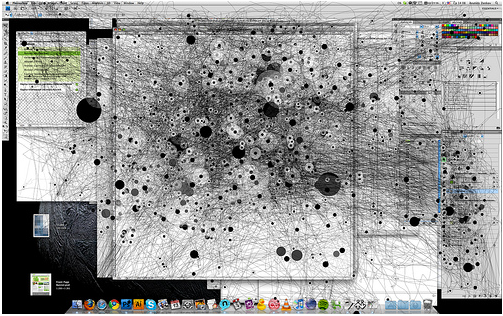
Spider.IO, a fraud analytics company, recently disclosed that under Internet Explorer attackers can capture mouse movement events from outside an open window. What is the Actionable Intelligence here? It’s moderately tempting to reply: We have a profound new source of modern art.

Original source: https://dakami1.files.wordpress.com/2012/12/psmap.png?w=595
(Credit: Anatoly Zenkov’s IOGraph tool)

I exaggerate, but not much. The simple truth is that there are simply not many situations where mouse movements are security sensitive. Keyboard events, of course, would be a different story — but mouse? As more than a few people have noted, they’d be more than happy to publish their full movement history for the past few years.

Read the rest of this entry »

DakaRand 1.0: Revisiting Clock Drift For Entropy Generation

“The generation of random numbers is too important to be left to chance.” —Robert R. Coveyou

“One out of 200 RSA keys in the field were badly generated as a result of standard dogma.  There’s a chance this might fail less.” –Me

[Note:  There are times I write things with CIO’s in mind.  This is not one of those times.]

Original source: https://dakami1.files.wordpress.com/2012/08/dakarand.png?w=595

So, I’ve been playing with userspace random number generation, as per Matt Blaze and D.P. Mitchell’s TrueRand from 1996.  (Important:  Matt Blaze has essentially disowned this approach, and seems to be honestly horrified that I’m revisiting it.)  The basic concept is that any system with two clocks has a hardware number generator, since clocks jitter relative to one another based on physical properties, particularly when one is operating on a slow scale (like, say, a human hitting a keyboard) while another is operating on a fast scale (like a CPU counter cycling at nanosecond speeds).  Different tolerances on clocks mean more opportunities for unmodelable noise to enter the system.  And since the core lie of your computer is that it’s just one computer, as opposed to a small network of independent nodes running on their own time, there should be no shortage of bits to mine.

At least, that’s the theory.

Read the rest of this entry »